
If you are hunting for the fastest payout casino USA operators, this is the page we built for you. Every other guide on JackpotLedger points back here, because payment behavior is where a casino either keeps its promises or quietly breaks them. A generous no deposit bonus means nothing if the winnings take two weeks to reach your bank, and a modest offer at a site that pays inside a day beats a big one that stalls. We log the money moving in and the money moving out, with timestamps.
Here is the framing we use throughout. A fast payout is really two things working together — an operator that approves withdrawals quickly and a payment rail that settles quickly — both gated by a one-time identity check. Line all three up and cash can reach you within hours; miss one and you wait. This page walks through deposits, withdrawals, KYC, pending periods, fees and how a bonus clears to spendable money, all in US dollars. Last updated: 07/20/2026.
What Determines Payout Speed at a Fastest Payout Casino USA
Advertised withdrawal times and real withdrawal times are rarely the same number, and the gap is where most player frustration lives. An operator can honestly quote "PayPal payouts in 24 hours" while your first withdrawal takes four days, because that clock usually starts after approval, not when you click the button.
At the best online casinos USA players can reach, three levers decide speed: how fast the operator reviews a request, how fast the chosen rail settles, and whether your identity is already verified. The first two are the casino's job; the third is largely yours, and the one most players underestimate.
The Four Stages Between Request and Cleared Cash
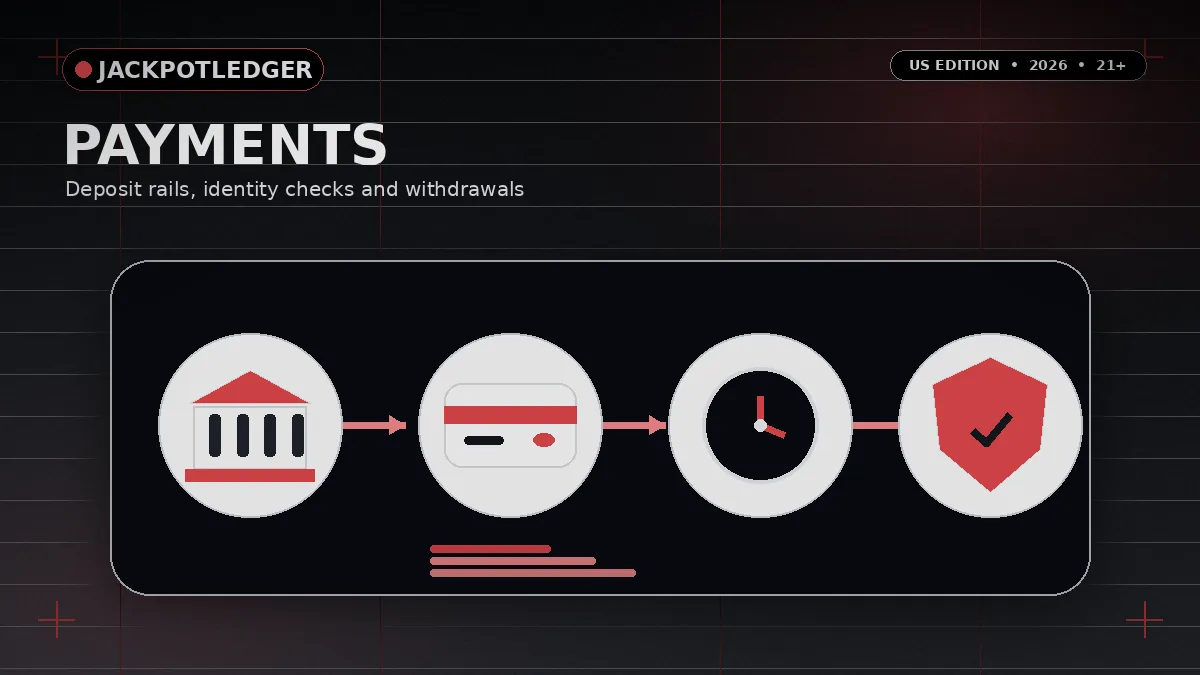
Every withdrawal moves through four stages. First is the request, when you enter an amount and confirm. Second is review, where the operator checks the account, applies any pending period and approves the payout. Third is processing, where the money is handed to the rail. Fourth is settlement, when funds post to your bank, card or wallet.
A fast casino compresses review and processing; a fast rail compresses settlement. Verification sits across the first two stages and can dwarf everything else, which is why we measure the whole chain from click to cleared cash rather than the slice an operator chooses to quote. Two people cashing out the same amount on the same day can wait very different times depending on whether they verified early and which rail they picked.
Deposit Methods US Players Actually Use
Deposits are the easy half of the story: nearly every method funds your account instantly, so the choice matters less for speed than for what happens later. The rail you deposit with often becomes the rail you must withdraw to, so a smart deposit decision is really a payout decision in disguise.
At regulated real money casinos the menu is built around US banking, not the grab-bag offshore sites advertise. Our real money casinos USA guide covers how to confirm a license before you fund anything; the methods below are what you will meet in a legal-state cashier.
Online Banking, ACH and PayPal
Online banking and ACH transfers are the backbone of US casino payments. You link your bank or authorize an electronic transfer, deposits land instantly, and the same connection returns withdrawals to a fully verified account. Because the money moves inside the regulated banking system, these rails rarely cause payout headaches.
PayPal has become a favorite at licensed operators for good reason: deposits are instant and withdrawals are among the quickest, frequently landing in hours once verification is done. It also adds a layer between the casino and your bank details, making it one of the strongest choices for a fast, clean payout.
Play+, Cards, PayNearMe and Cash at the Cage
Branded Play+ prepaid cards are purpose-built for US gaming: you load funds, play, and withdrawals can return to the card quickly, often usable at ATMs. Debit cards are widely accepted for deposits; credit card deposits work at some operators but are blocked by many issuers, and using credit to gamble is a habit we would steer you away from regardless.
To keep gambling off a main bank statement, PayNearMe funds an account with cash at a participating retailer, and operators tied to a physical casino may let you deposit or collect winnings at the cage. Bank wires exist mainly for larger sums and tend to be slower, so wherever possible, deposit with a method that can also pay you back.
Withdrawal Methods and Typical Timeframes in USD
Withdrawals are where the differences between methods stop being academic. Two rails can both be supported while one pays in hours and the other in a week, and the operator's own approval speed sits on top of that. The figures below are realistic ranges across regulated US operators, in US dollars, assuming your identity is already verified.
Treat every range as example data, not a guarantee tied to any operator. Your actual time depends on the pending window, the day of the week and whether it is your first cash-out — but the fast options are almost always the digital ones.
The Fast Rails and the Slow Rails
The fast rails are digital and account-linked: PayPal, online banking or ACH, and Play+ prepaid cards. Once an operator approves the payout, these typically settle from a few hours to about two business days, which is why they anchor almost every fastest payout casino USA shortlist. If speed is your priority, pick from this group and verify early.
The slow rails are the traditional ones. Card withdrawals can take one to five business days, bank wires are reliable for big sums but seldom quick, and a paper check mailed to your address is the slowest of all. None are untrustworthy; they simply were not built for speed.
The table below sets deposit speed, withdrawal speed, typical fees and typical minimums side by side. Read it with your own goal in mind: a player cashing out a small bonus win wants low minimums and speed, while someone moving a larger balance may accept a wire's fee for reliability. The pattern is clear — the methods with no fees and low minimums are also the fastest, because digital, account-linked rails are cheaper to run and easier to verify.
| Payment Method | Typical Deposit Speed | Typical Withdrawal Speed | Typical Fees (USD) | Typical Min Withdrawal (USD) |
|---|---|---|---|---|
| Online Banking / ACH | Instant | 1–3 business days | Usually none | $10–$20 |
| PayPal | Instant | A few hours to 24 hours | Usually none | $10–$20 |
| Play+ Prepaid Card | Instant | A few hours to 48 hours | Small monthly / ATM fees | $10–$20 |
| Debit Card | Instant | 1–5 business days | Rare processing fee | $10–$20 |
| Credit Card | Instant (if accepted) | Often not eligible for payout | Possible cash-advance fee | N/A |
| PayNearMe (Cash) | Same day, in person | Not typically a payout method | Usually none | N/A |
| Cash at Casino Cage | Same day, in person | Same day, in person | Usually none | Varies by property |
| Bank Wire Transfer | Same day to 1 day | 2–5 business days | Possible wire fee | $50+ |
| Paper Check by Mail | Not applicable | 5–10 business days | Occasional mailing fee | $50+ |
What Speeds a Payout Up
- Completing identity verification at sign-up, not at cash-out
- Choosing a fast digital rail — PayPal, online banking or Play+
- Withdrawing to the same method you deposited with
- Requesting on a business day, away from weekends and holidays
What Slows a Payout Down
- Leaving KYC documents until your first withdrawal request
- Picking a paper check, wire or card payout for speed
- Name or address mismatches across your ID and account
- Long or vaguely worded pending periods on the operator's side
No Deposit Bonus KYC in 2026: The Verification Bottleneck
Know Your Customer, or KYC, is the identity check every licensed US casino must run, and it is the true bottleneck behind slow payouts in 2026. It exists to stop fraud, underage play and money laundering, so it is not optional and not a sign of a shady site. The players who complain loudest about delays usually skipped this step at registration and collided with it at cash-out.
The good news is that verification is a one-time hurdle you can clear before it ever matters. Do it right when you open the account and a future bonus win can move straight to payout. Because it decides almost everything about your first cash-out, it earns its own walk-through below.
The Documents a Licensed Casino Requests
Expect to provide three things: a government-issued photo ID such as a driver's license or passport, proof of address like a recent utility bill or bank statement, and, at some sites, proof that you own the payment method. Your Social Security number may be requested to confirm identity and support tax reporting, which is standard for a regulated US operator.
The detail that trips people up is consistency. The name on your ID, on your casino account and on your payment method must match. A maiden name, a nickname or an old address can each stall a review while the operator asks for more. Clear, legible photos of unexpired documents move fastest.
Why KYC Is the Real Bottleneck
Payment rails are mostly fast; verification is what makes a first withdrawal feel slow. Because these checks often trigger at the initial cash-out, the review time gets blamed on the payout when it really belongs to the paperwork. The fix is obvious: move the paperwork earlier.
Upload your documents the day you register. Most sites let you verify before you have any winnings, and a pre-cleared account behaves like a repeat customer on its very first payout. For why operators must run these checks, our licensing and regulation guide lays out the state framework that requires them.
Pending Periods, Reversals and Funds in Limbo
Between requesting a withdrawal and seeing it hit the rail, many casinos apply a pending period, a review window where the payout sits in limbo. Used honestly, it is a short, clearly stated buffer for final checks; used badly, it becomes an open-ended stall we flag against an operator.
The pending period is also where the reversal feature lives, and it is a genuine trap for players who lack discipline. Understanding both mechanics keeps your money moving toward your bank instead of back onto the felt.
How the Pending Window Works
A typical pending window runs from a few hours to a couple of business days while the operator confirms the account, finishes any verification and approves the payout. A site that states the window plainly and sticks to it is doing exactly what it should. What you want to avoid is an operator whose pending time keeps quietly extending each time you check.
Weekends and holidays legitimately lengthen the window on bank-based rails, which settle only on business days. That is different from an operator sitting on an approved payout, and part of our testing is separating the two so a normal delay is never mistaken for a stall.
Reversal: Why Not to Cancel a Withdrawal
Reversal lets you cancel a pending withdrawal and drop the money back into your playable balance. It sounds convenient and it is quietly costly: the most common reason a cashed-out balance disappears is a player reversing the withdrawal and gambling it away.
Our advice is simple. Once you request a withdrawal, treat it as gone from your bankroll. If a site makes reversal the default or nags you to cancel, that is a design choice working against you.
Fees, Minimums and Withdrawal Limits in USD
Fees at regulated US casinos are usually small or absent, but not always where players expect. The casino itself rarely charges for a standard withdrawal; when a cost appears, it typically comes from the payment rail. Knowing the difference stops you blaming an operator for a bank's wire fee.
Limits matter as much as fees, especially with promotional money. A no deposit bonus often pairs a low cashout cap with the site's normal minimum withdrawal, which can leave your entire eligible balance in a narrow band. Reading both numbers in the cashier before you play saves a surprise at payout time.
Where Payout Fees Actually Come From
Online banking, ACH and PayPal withdrawals are usually free at licensed operators. Prepaid cards like Play+ may carry small monthly or ATM fees set by the card program, not the casino, and bank wires or mailed checks can add a fee. Every one is disclosed on the cashier or terms page in US dollars.
If a site charges a fee to process an ordinary withdrawal of your own cleared funds, treat that as unusual and read the terms twice. In a healthy US market, standard payouts on mainstream rails should not cost you anything.
Minimum and Maximum Withdrawal Limits
Minimum withdrawals commonly land between $10 and $50, with wires and checks often higher. Maximums matter too: many operators cap daily, weekly or monthly totals, so a large win may be paid in installments rather than one lump sum. A very low maximum paired with a big balance is worth knowing before you celebrate.
With a real money no deposit bonus, the cashout cap usually bites first, limiting winnings to a modest figure such as $50 to $100. Compare that cap to the method's minimum: if the cap is $50 and your fastest rail has a $20 minimum you are fine, but a $50 minimum on a $50 cap leaves no room for error.
How a No Deposit Bonus Clears to Cash in 2026
This is the question that brings most players to the page: how does a free credit turn into money in my account? The answer is a two-step journey, each step with its own gate. Skip a detail in either and the winnings you thought you had can evaporate, which is why we track a no deposit bonus from claim to cleared cash in 2026.
The core idea is that a no-deposit offer is locked until you satisfy its terms, and only then does it behave like real money — flowing through the same payout process as any other balance, subject to the cashout cap. Our casino bonus USA guide digs into the terms; here we focus on the mechanics of getting paid.
Step One — Clearing the Wagering Requirement
Before a cent is withdrawable you must meet the wagering requirement: the multiple of the bonus you have to bet, often 20x to 60x. A $20 credit at 40x means $800 in total wagering. Slots usually count fully toward that target, which makes them the practical choice for clearing a bonus, while table games often count far less.
Watch the fine print while you grind. Some offers exclude certain games, cap the maximum bet while a bonus is active, or set a short expiry, and breaking any of those can void the winnings. Our US online slots guide covers which titles clear a requirement efficiently without tripping those limits.
Step Two — From Cleared Balance to Payout
Once the wagering is done, eligible winnings up to the cashout cap convert from bonus funds into a real, withdrawable balance. Now the payment side takes over: you open the cashier, choose a method, request the amount, and the withdrawal enters the same four-stage pipeline as any other payout. If you verified early, this is quick.
This is the exact moment KYC pays off. A player who verified at sign-up sees the balance move into review and out to a fast rail, sometimes within a day. A player who did not waits on documents while the funds sit idle — how a promising deal turns into a frustrating week.
Crypto, Sweepstakes Redemptions and Offshore Payouts
Crypto comes up constantly in payout conversations, so it deserves an accurate, cautious answer rather than hype. The short version: at state-licensed real money casinos, cryptocurrency is uncommon. Those operators are built on regulated banking rails — online banking, PayPal, Play+ and cards — because that is what fits their licensing framework.
Where you do see crypto, and aggressive "instant payout" marketing, is largely at sweepstakes and offshore sites. We treat their speed claims with skepticism, because a fast advertised time means little without a US regulator standing behind the payout.
Why We Stay Cautious on Offshore Claims
Offshore operators sit outside the state-by-state system that governs legal US play. Federal statutes such as UIGEA (2006) and the Wire Act (1961) shape how gambling-related payments and wire communications are handled without creating any national casino license, so an offshore site's marketing is bound by no US regulator.
Our stance is to log the risk, not the sales pitch. If your state has legal online casinos, a licensed operator is the safer home for both deposits and winnings; if not, a sweepstakes site is usually the compliant route. Either way, we would rather you have a slightly slower payout you can collect than a fast one you may never see.
How We Time and Log Every No Deposit Bonus Payout
JackpotLedger exists to replace marketing claims with measured data. We do not publish a withdrawal time an operator hands us; we open a real account, move real money, and time the whole thing.
The method is deliberately unglamorous, because unglamorous is what catches problems. We repeat it on a schedule, since a site that paid fast last quarter can slow down after an ownership change. It is how operators earn a place among our top rated US casinos.
Our Timed Withdrawal Test
We register a genuine account, complete KYC as a first-time player would, and where available claim the no deposit bonus and clear its wagering on eligible slots. Once a small withdrawable balance exists, we request a payout and start the clock, logging each stage — request, review, processing and settlement — with timestamps until the money clears.
Alongside the payout, we open a support ticket with a specific question and time how long a real answer takes. Sites that answer pre-signup chat instantly but go quiet at withdrawal time reveal their priorities, and that pattern predicts a rough cash-out. Every figure lands in the ledger with a date attached.
Payout Red Flags We Log
A handful of warning signs push a site down our rankings before a payout ever gets stuck. We watch for each of these and weight them heavily against an operator.
- Pending periods that keep extending or are never stated in writing
- Reversal set as the default, or repeated prompts to cancel a payout
- Withdrawal times that do not match the posted cashier terms
- Fees on standard withdrawals of your own cleared funds
- KYC requests that arrive one document at a time to delay you
- A "federal casino license" claim, which does not exist in the US
Any one of these might have an innocent explanation, but two or three together are a reason to withdraw and move on. You can compare an operator's record against newer entrants in our new US casinos guide, and everything traces back to the hub — our no deposit bonus ledger — where the full scoring lives.
Responsible Play, 21+ and Staying in Control
Fast payouts are a good thing, but the healthiest relationship with a casino is one where withdrawing is routine and chasing is absent. Everything on this site assumes an audience of adults — 21 and over in regulated states — playing with money they can afford to lose and treating any win as a bonus rather than a plan.
Working responsible gambling tools are also a mark of a well-run operator. Deposit limits, session reminders, cool-off periods and self-exclusion should be easy to find and easy to switch on, and we factor their presence into every score. Set them while you are thinking clearly, not after a losing session.
21+ only. If gambling stops feeling like entertainment — you are chasing losses, hiding play, or spending more than you planned — free, confidential help is available 24/7 from the National Council on Problem Gambling. Call or text 1-800-GAMBLER, or use its online chat. You can also enroll in your state's self-exclusion program or a casino's own voluntary self-exclusion, and set deposit and loss limits inside your account.
Sources
- National Council on Problem Gambling — free, confidential help, call or text 1-800-GAMBLER
- American Gaming Association — US casino industry data and payments policy
- NJ Division of Gaming Enforcement — regulator overseeing New Jersey online casino payouts
Read more
- real money casinos USA — deposits, wins and withdrawals
- casino bonus USA — offer types and wagering terms
- licensing and regulation — state rules behind KYC
- US online slots — clearing a bonus efficiently

Carolyn J. Stokes
Payments & Payouts Editor · JackpotLedger
Carolyn J. Stokes is the Payments & Payouts Editor at JackpotLedger, where they run timed withdrawal tests across regulated US operators and document every KYC checkpoint from account opening to cleared funds. Their work focuses on payout-speed benchmarking, payment-method reliability and the verification steps that decide how fast a no deposit bonus actually becomes withdrawable cash.
Last updated 07/20/2026